As summer kicks off this year, the perennial reminders about sunscreen use follow. In the northern hemisphere, longer days compounded by more intense sun and outdoor activities means lots of sun! But how does it work? Why would a white to transparent paste or spray make any difference?
Not all light is the same
It may seem counterintuitive that a paste that is often transparent after you apply it would really make a big difference against sun damage. If you can see through it, how can it really protect you from harmful sun rays? It may seem transparent to the naked eye, but this is because we can’t actually see the harmful rays from the sun. If our eyes could see in UV light, most sunscreen would look black. To find out why, keep reading!
What is light?

Light can be thought of as photons being delivered to our eyes at a rate, or frequency which our eyes can detect. At the same time, think of light as a wave of energy that can have different spacing between the tops of the waves, or wavelengths. This field of energy made up of traveling photons is called electromagnetic radiation (EMR). Depending on the wavelength, any type of EMR can be formed, ranging from radio waves with massive wavelengths the size of buildings to gamma rays with wavelengths the size of atomic nuclei (Figure 1).
What is UV Light?

UV stands for ultraviolet, which means that it is EMR that has a frequency that is higher than the visible color violet, but lower than an X-ray. Higher frequency light has more frequent wave oscillations and more energy per photon delivered. These qualities alone are what makes radio waves and cancer radiation treatment different, but it makes all the difference. In fact, radio waves are vastly lower energy than the light coming off of the screen you are reading this on. Although not high enough energy to knock electrons off of atoms (which would be “ionizing” radiation such as X-rays or cancer radiation treatment), UV rays have the ability to damage our DNA and other molecules in our skin.
How does UV light damage our skin?

The types of UV rays that reach our skin are ~ 95% UVA, and 5% UVB. UVA is slightly lower frequency, penetrating to the deeper layers of our skin causing damage which stimulates tanning, wrinkles, and free radical formation. On the other hand, UVB doesn’t penetrate as deeply, but damages DNA in the top layers of your skin which can cause skin cancer. Too much UVB also causes permanent clouding of the lens of our eyes, called cataracts. This comprehensive review is a great resource. UVB causes DNA damage by photons triggering bonds between structures of the DNA that should not be formed. These inappropriate bonds make the DNA hard to read, and may lead to cancer if our bodies make mistakes repairing this damage (Figure 2).
In a sort of double whammy, UVB damage not only increases the risk of skin cancer formation, it suppresses the immune system which safeguards against cancer formation. This happens because UV rays alter important molecules the immune system uses to communicate, leading to defects in the development and efficacy of important immune cells. This increases the risk of skin cancer and infectious diseases, though there are also some possible beneficial effects of these alterations. UV rays also induce many changes leading to photoaging, or visual signs of aging due to sun exposure. Various mechanisms are responsible, such as up-regulation of MMPs leading to increased collagen degradation, formation of reactive oxygen species, direct damage to elastin fibers, formation of sunspots from uneven melanin formation, and more. The effect of this photoaging is classically seen in this photo of a truck driver who drove trucks with uneven exposure to UVA sun through his truck window for his 25 year driving history. A great explainer video with visuals can be found here.
How Does Sunscreen Protect Us?
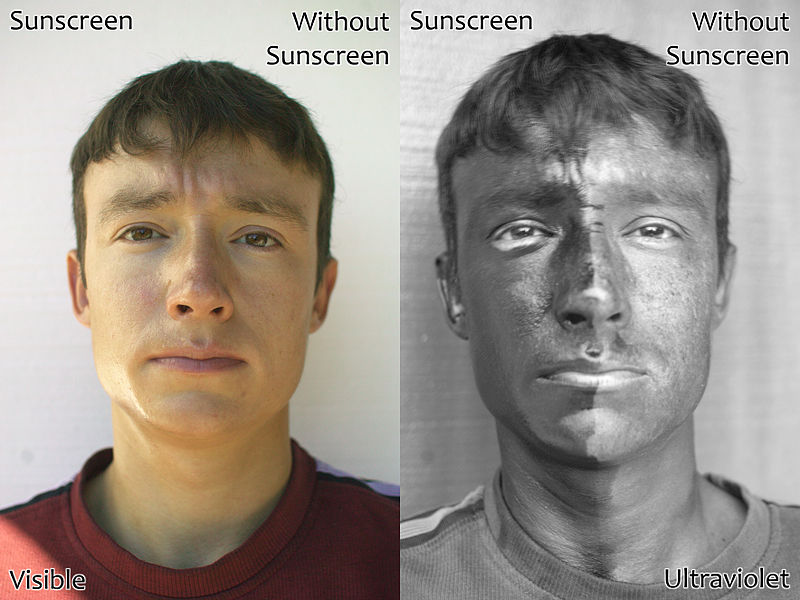
Let’s return to the phenomenon of sunscreen when viewed through a UV camera. Most sunscreen will appear as a black paste as seen in Figure 4. This is because UV rays are “absorbed” and do not reflect back or through the sunscreen. Here is a great video which covers this topic and more. Think about how the color black “attracts” more heat. This is because the visible light spectrum is absorbed by the structure of the pigments making the color black, and the energy of the light is converted into heat. Now think of sunscreen as more or less the same thing, but for UV light and not visible light.

The way sunscreens absorb UV light is by converting the energy of the UV light into a harmless form, such as infrared light or heat. The unique chemical structure of the active ingredients allow for the transfer of UV ray energy to their electrons, bumping them up to a higher energy state. As the resting state of these electrons are not at this high energy level, this excess energy is re-emitted from the atoms when the electrons “relax” back to their ground state.
Chemical vs Physical Sunscreen
Ultimately, the term “chemical” sunscreen is a misnomer, as both physical and chemical sunscreens are made of chemicals, as is nearly everything we interact with in the world. However, we can think of chemical sunscreens as organic (made of carbon containing molecules), and physical sunscreens as inorganic, as their active ingredients do not contain carbon. Common organic sunscreen ingredients include oxybenzone, avobenzone, and octocrylene. Inorganic sunscreens are sometimes called “mineral” sunscreens, and contain zinc oxide and titanium dioxide. It is often incorrectly stated that inorganic sunscreens act by reflecting UV rays, while organic sunscreens absorb them. However, only about 5% of UV rays are scattered or reflected, whereas the other 95% is absorbed just like with organic sunscreens.

One major difference between organic and inorganic sunscreens is that organic sunscreens tend to leave a whiter residue due to their ability to readily reflect visible light. Another is that zinc dioxide and titanium dioxide absorb a broader spectrum of UVA and UVB rays than organic sunscreens alone. Organic sunscreen ingredients block narrower ranges of UV alone, which is why they are typically used in combination with various other organic ingredients or inorganic ingredients.
How to Best use Sunscreen
All of this talk about the mechanism of sunscreen means absolutely nothing if it is not used! Using even low SPF sunscreen significantly reduces your lifetime exposure to UV, and therefore your risk of skin cancer and skin aging. SPF is a measure of how many times more UVB you can receive before getting sunburnt, which is NOT proportional to time spent in the sun as UV dose varies greatly in the real world. This is why no matter the SPF you use, you should still re-apply every 2 hours. The protective film will break down at a similar rate, from natural oil production on our skin, abrasion from your environment, and exposure to water. Applying enough and covering all exposed surfaces is also absolutely vital for effective sun protection. Sunscreen and sun protection of any amount is better than nothing. Ideally, apply 1/4 of a teaspoon on your face or a shot glass worth of sunscreen for the entire body 15 minutes before you go outside. Aim for a sunscreen with a broad spectrum protection to cover UVA, and an SPF of at least SPF 30. Reapply every 2 hours with normal activities, every 80 minutes with sweating or swimming, and immediately after towel drying.

 Living The Lifestyle

